Thursday, September 27, 2018

The streets of Saigon


A short two day visit to Viet Nam's largest city, Saigon (or officially, but not often used, Ho Chi Minh City) left me with wonderful memories of meeting friendly people and seeing the fascinating culture on the streets of the main part of the city, District 1. As my former teaching colleague and fellow photographer Jason Cordray, who lives in Saigon summed it up: "Elegance and decay weave a tapestry of urban life here."

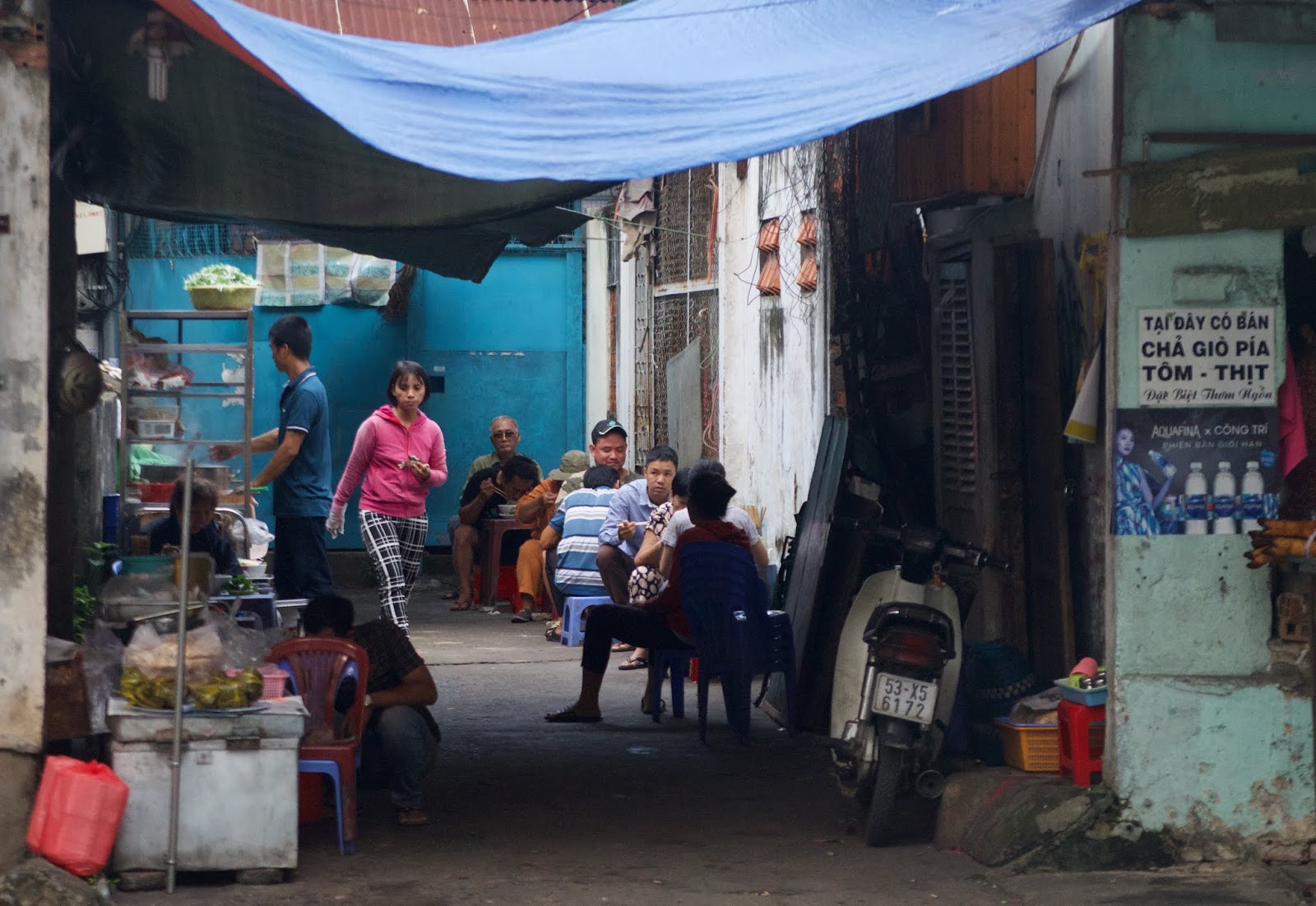
Everywhere I went, there were people sitting in groups on the sidewalks, sharing a meal or drinks or just friendly conversation. It is a very social society.


From the moment I began exploring this city of nearly seven million inhabitants, I saw that its atmosphere and cultural signatures are different than in other cities, but also there is a familiarity that tapped on my memory, with wisps of images of other places in Asia, yet it is distinct, even from its in-country neighbor to the north, Hanoi.

Saigon is at once beautiful and degraded, sleekly modern and ancient, international and traditional. Walking the streets of Saigon is an unforgettable and exhilarating experience. I hope you enjoy the tour, and plan your own visit to this enchanting city.

All photos are copyrighted © by the author. It is illegal to use any images for any use, commercial or non-commercial without permission. If you have inquiries, please contact me at stilesphoto@yahoo.com.


Rising early on my first morning, I took a short walk through the neighborhood near the Saigon River in District 1. I didn't have to go far before I encountered scores of people buying fruit, omelettes, breads, and drinks for breakfast.


This man insisted that I take his picture.

Tiny shops, most a meter off the ground, were packed with just about anything one would ever need.

In a small alleyway, a man prepares food for locals.

It is not hard to imagine this woman doing the same thing in the same shop 50 years ago.

Bamboo and weathered concrete combine to form a beautiful image.

I met smiling people everywhere.

The popular Ben Thanh market is under renovation, so the stalls have moved to nearby streets. It is a sensory overload!

These bags are full of various types of sugar!

A remarkable variety of mushrooms.

This woman was tediously (but very quickly) peeling water chestnuts. It took her about five seconds to completely peel one.

A common sight is people moving huge loads of commerce through the narrow streets. Whether over the shoulder, by motorcycle, hand truck or yoke baskets, they moved a lot of inventory!

The meat market

A commonplace small business is the mobile carrying pole with two baskets or buckets (depending on what they are selling) on both ends.

A young man takes a cigarette break.

Ben Thanh market is undergoing renovation.

In Chinatown, shops are jam packed with festive paper lanterns and other decorations.

Colorful decorations for the upcoming Mid-Autumn Festival. Unfortunately, I was a bit early.

Inside a Chinese Buddhist temple we came across several young men working on a long dragon that they will dance under in the festival parade.

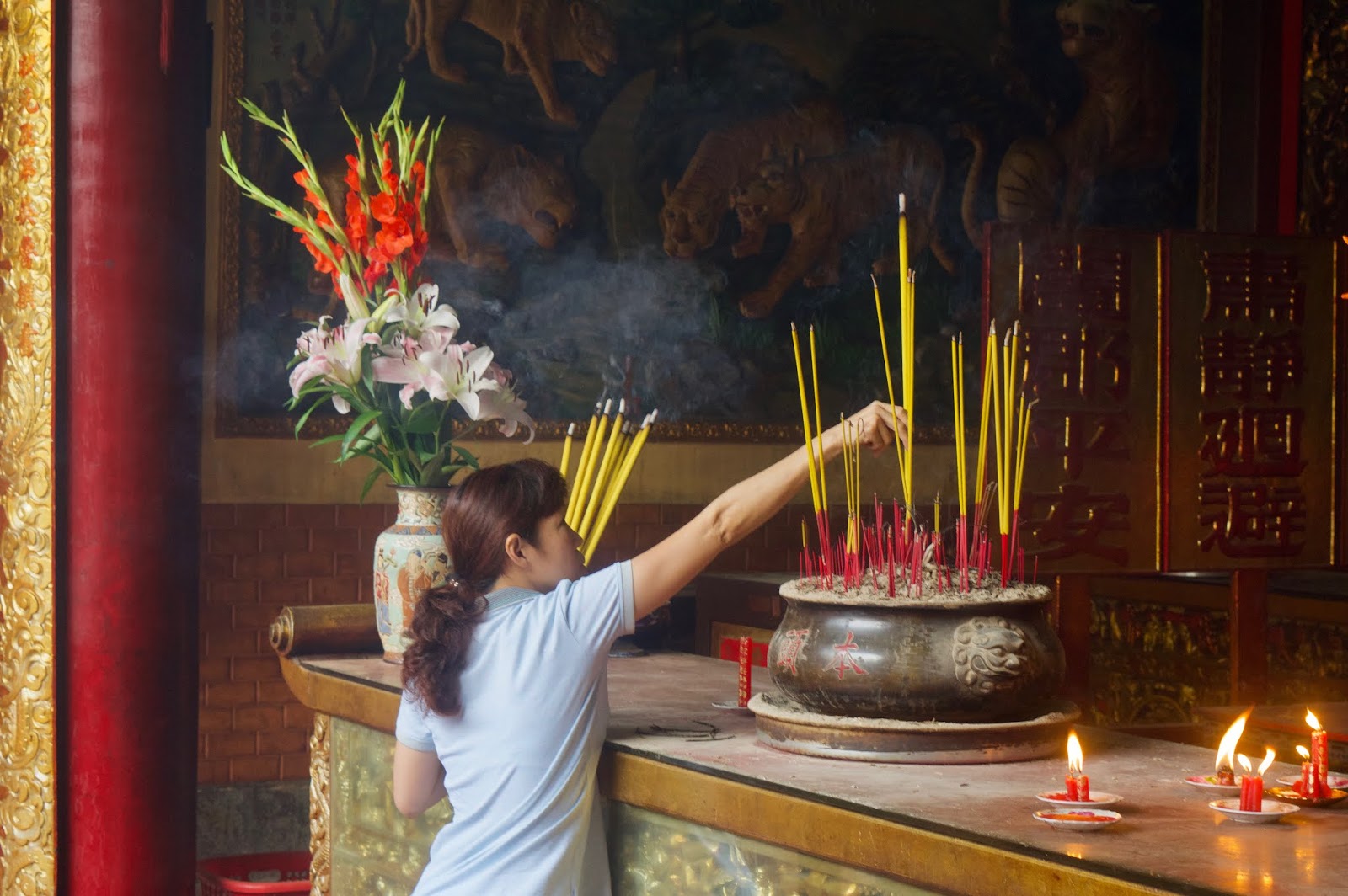
A woman places large joss sticks at various altars in the temple.

Two men pass the time in conversation and drinking tea at the temple.

A woman pauses to pray before placing joss sticks in sand-filled bowls around the temple.

This old woman must have been in her 90s. She walked slowly through the alleyway, pausing any time a chair was available for resting. 
The "elegance" to which my friend Jason referred is found mainly in the beautiful French colonial style buildings that are scattered about the city, many in District 1. the Vietnamese have restored them and they continue to be in use.


The Saigon Opera House

Ho Chi Minh City Hall, finished in 1908.

Hotel Majestic, built in 1925 by a Chinese business man in the French colonial and French Riviera styles.

Hotel entrance

Hotel reception lounge

Gorgeous Majestic windows
Quite noticeable everywhere is the practice of "motorcycle perching." The people of Saigon have perfected it!


In this city of motorcycles, nearly everyone wears a helmet.
Motorcycles are ubiquitous in Viet Nam. It is gratifying to see that nearly all who drive or ride on motorcycles wear helmets. I am especially pleased to see that children's safety is a priority in this country, unlike in so many others in Southeast Asia.
As in many cities, graffiti art graces many of Saigon's walls. The paintings are often both stylistic and thematic.

Friendly smiles are seen everywhere in Saigon.

These are air roots of the oldest tree in Saigon (approximately 300 years). 

A woman sleeps on the ground in a covered passageway. I do not know if she was homeless, but there was a small altar and some belongings next to her.
Saigon has many upscale and sub culture cafes, book stores and coffee houses. This one is popular with both tourists and Vietnamese: the Propaganda Cafe, which has a revolutionary theme.

In step with places around the world, Vietnam has its own craft breweries. This one is on Pasteur Street, from which it got its name. The beer shown is quite unique: dragon fruit gose, which has a sour, fruity taste. 

An air conditioner had just been lifted through the upper window. As for the towels in upper left, my experience tells me they are from a massage shop.

A lot of people in Saigon nap in the daytime, and just about anywhere. This old man slumbers on a furniture display in a park.
There are two model boat builders near the Opera house. The scale models they build are amazingly detailed.

Vietnamese know this best.

An iconic street scene in Saigon.

Parents and grandparents were happy to show off their children to us.


View from the 49th floor of the Bitexco Building, across the Saigon River to the Landmark 81 building, now the tallest building in Southeast Asia.

I hope you enjoyed the photo tour of Saigon/Ho Chi Minh City. If you ever have the chance to visit the city, do. You won't regret it! 

Contact me at stilesphoto@yahoo.com

Friday, August 24, 2018

Ramble to a tiny Chinese Thai village in Bangkok


Wonderful old Chinese style doors line the passageways through the village.
Bangkok Photo Rambles (my fellow photographer friend Jeremiah Boulware and I) set out once again to explore a tiny traditional Thai village tucked away between one of Bangkok's busiest roads and the main east-west klong (canal), Saen Saeb. It was a short distance by foot from the main road, but quite a distance away in time: except for the obvious modern conveniences of motorcycles and smart phones, it hasn't changed much in the last century. The Chinese style wooden homes have the original boards and doors from a hundred years ago.

As usual, the residents were wonderfully accommodating, not only welcoming our intrusion into their humble lives, but gladly allowing us to photograph cheewit thai ("Thai life"). When two westerners over six feet tall wander down the narrow lanes, it's impossible for them to be unobtrusive, no matter how hard they try. People waved and said "Sawat dee" ("Hello!") as we rambled. It is one of the great things about living in Thailand.

I hope you enjoy this pictorial of our latest walk through a Bangkok Thai Chinese village. A full album of photos of our excursion with images from both photographers will be published soon in Bangkok Photo Rambles (https://www.facebook.com/photoramblers).

All photos are copyrighted by the author. No images may be used or reproduced without permission from the author. If interested in any image for non-commercial or commercial use, please contact me at stilesphoto@yahoo.com.


Jeremiah captures a photo of a Buddhist monk on his morning alms rounds.

Above many doorways are symbols and pictures that signify good fortune for the inhabitants, a Chinese tradition that has been adopted by many Thais.

Besides displaying good luck ornaments, the doors and walls are often painted in bright colors.

But most are left to weather naturally, giving an authentic, time worn appearance.

This accidental art piece left us wondering about the person who left his/her mark.


I had seen this fish processing area on a previous walk, but from another direction. It is a fascinating look at how fresh fish are prepared for the nearby market in Minburi, which is across the Saen Saeb canal.

The men who work here (we saw no women) begin each day receiving deliveries of fresh mackerel at 2:00 am, and work until about 9:00 cleaning, cooking and packing the fish into small baskets. Here a man boils the fish after they have been cleaned. "How long are they boiled?" "Three minutes."

This man is scooping fat from the surface as the fish boil. He then simply tosses it onto the ground next to the building.

This room is used to store the gas tanks, hand carts and baskets used in the processing. The morning light gave a beautiful cast to the wood and bricks.

This man carries the prepared and packaged fish to the market, which is about 300 meters away.

This woman carried freshly cooked chickens to the market, making several trips while we were there. She said that she has been doing this since she was a child.

This old boarded up window and the now unused concrete fish tank below it created a gorgeous palette of muted colors.

A woman washes dishes in her house as one of the many chickens she owns rests on the family motorbike. The fowl did not leave its spot for the hour we were in the vicinity.

A woman carries her grandson to the nearby preschool. Jeremiah records my documentation!

It is a unique cultural experience to walk through traditional neighborhoods and meet the residents, which results in a greater understanding and deeper appreciation for the people who live there.

Saturday, July 28, 2018

Life in a canal-side village in Bangkok

Many of the bridges that span the canals are still the original wooden ones, but are being steadily replaced by concrete overpasses.

One of the pleasures of living in a large city (10 million) is that there are still delightful pockets of traditional life to be found not far off the major streets. Many canals ("klongs") remain, much fewer than a hundred years ago, but still major influences on the lives of thousands of villagers who live on them. This post is a record of a visit to one of many villages that lie between Ramkhamhaeng and Serithai Roads (also known by their previous pre-development names Sukhapibahn 3 and Sukhapibahn 2, respectively), large, busy parallel thoroughfares that traverse Bangkok's easternmost districts.

I have wandered through this village more than once (see Bangkok Photo Rambles  https://www.facebook.com/photoramblers/), and each time notice something new, greet people previously met, and am greeted by new friendly faces. During a recent ramble, photographer friend Jeremiah Boulware (https://jeremiahboulware.com/) and I returned to wander some familiar paths and to explore new ones. Here are my photo impressions. More will soon be posted on Bangkok Photo Rambles, including Jeremiah's images of the morning.

Note: All photos are copyrighted by the author. No images may be used for any purposes without permission. Please contact me at stilesphoto@yahoo.com


A typical scene of walkway construction along the canals. This one is made of concrete, which replaced the deteriorated wooden one.

Although the majority of the inhabitants are Muslim, there is a Chinese Buddhist temple in the middle of the village. 

A beautiful butterfly with a damaged wing kindly pauses for a photo.

As this was a major holiday, lottery sales were brisk. Here a man rides through the neighborhood with tickets to sell.

A beautifully weathered door with seashell adornments on the window grate. The planks at the bottom form a ramp for the owner's cat to freely access and leave the house.

There are many cats living in this village, which wander along the walkways, hiding in bushes and behind ceramic water tanks.

This old chain has apparently been repaired recently.

It is unusual to see lace curtains here. I do not know the origin of this one, which was folded over an outdoor railing.

A woman and her daughter set up their portable shop, which has items hanging from a frame on a pickup truck. This is a common sight in Thailand.
We chose to walk along a newly asphalted street tht runs along an adjoining klong that we had not explored before. There were many interesting sights along the way.


A small cement statuary piece. Children and animals are often depicted on these whimsical outdoor displays.

An elderly man collects twigs and branches from the canal banks and for a reason we could not determine, burns them.

This Chinese "spirit house" altar sits neglected under a tree near the bike path.

A young boy paddles a boat with his mother along the klong. When asked where they were going, she replied that her son enjoys going out in the boat, so they do it every once in a while.

Jeremiah captures images of a man checking his nets for fish and small river shrimp.

In the small nets were many small shrimp that he collected to be eaten, either dried or cooked. Many villagers still raise poultry and livestock, even in the city, or catch fish and/or plant fruit trees and gardens to supplement their diets.

In the large net were medium sized fish, which he left in, as the weight was too much for one person to manage and also collect the fish. He politely declined our offer to help; his wife will help him later.

As we left the klong and headed back toward the temple, we walked along a wider street that led us to a local school. Here another vendor cycles through the streets hoping for lottery ticket sales. 

A man sleeps alongside the street. Naps are a way of life here.

A broom salesman pedals through the streets, announcing his presence with a small bulb horn mounted on the handlebars. Each vendor's horn has a unique sound and rhythm, so residents know what product is coming their way.

A school van sits abandoned near the school.

Cooking pots in a window of the school's kitchen

A window in a passageway through canal-side shops.

A good luck ornament hangs above a house entrance.

A young girl gives a quick glance as she returns home from a nearby shop.

Two women wheel their portable grill (for making gai yang, or grilled chicken) from Ramkhamhaeng Road to the village. I was sorry that we were leaving, as gai yang is one of my favorite Thai foods, and it would take them awhile to cook it!

A man makes spicy papaya salad (som tam) on Ramkhamhaeng Road near the village. Many small food vendors were doing a brisk business on this holiday.

A woman from the village comes to buy food on Ramkhamhaeng Road.

A man sells many types of vegetables, including cooked corn (still warm) from his motorcycle. This is a common method of portable vending. We bought grilled chicken, spicy papaya salad and sticky rice before heading home.

Thank you for visiting this site. I hope you enjoyed the tour. Send questions and comments to me at stilesphoto@yahoo.com