Showing posts with label Canals. Show all posts

Saturday, July 28, 2018

Life in a canal-side village in Bangkok

Many of the bridges that span the canals are still the original wooden ones, but are being steadily replaced by concrete overpasses.

One of the pleasures of living in a large city (10 million) is that there are still delightful pockets of traditional life to be found not far off the major streets. Many canals ("klongs") remain, much fewer than a hundred years ago, but still major influences on the lives of thousands of villagers who live on them. This post is a record of a visit to one of many villages that lie between Ramkhamhaeng and Serithai Roads (also known by their previous pre-development names Sukhapibahn 3 and Sukhapibahn 2, respectively), large, busy parallel thoroughfares that traverse Bangkok's easternmost districts.

I have wandered through this village more than once (see Bangkok Photo Rambles  https://www.facebook.com/photoramblers/), and each time notice something new, greet people previously met, and am greeted by new friendly faces. During a recent ramble, photographer friend Jeremiah Boulware (https://jeremiahboulware.com/) and I returned to wander some familiar paths and to explore new ones. Here are my photo impressions. More will soon be posted on Bangkok Photo Rambles, including Jeremiah's images of the morning.

Note: All photos are copyrighted by the author. No images may be used for any purposes without permission. Please contact me at stilesphoto@yahoo.com


A typical scene of walkway construction along the canals. This one is made of concrete, which replaced the deteriorated wooden one.

Although the majority of the inhabitants are Muslim, there is a Chinese Buddhist temple in the middle of the village. 

A beautiful butterfly with a damaged wing kindly pauses for a photo.

As this was a major holiday, lottery sales were brisk. Here a man rides through the neighborhood with tickets to sell.

A beautifully weathered door with seashell adornments on the window grate. The planks at the bottom form a ramp for the owner's cat to freely access and leave the house.

There are many cats living in this village, which wander along the walkways, hiding in bushes and behind ceramic water tanks.

This old chain has apparently been repaired recently.

It is unusual to see lace curtains here. I do not know the origin of this one, which was folded over an outdoor railing.

A woman and her daughter set up their portable shop, which has items hanging from a frame on a pickup truck. This is a common sight in Thailand.
We chose to walk along a newly asphalted street tht runs along an adjoining klong that we had not explored before. There were many interesting sights along the way.


A small cement statuary piece. Children and animals are often depicted on these whimsical outdoor displays.

An elderly man collects twigs and branches from the canal banks and for a reason we could not determine, burns them.

This Chinese "spirit house" altar sits neglected under a tree near the bike path.

A young boy paddles a boat with his mother along the klong. When asked where they were going, she replied that her son enjoys going out in the boat, so they do it every once in a while.

Jeremiah captures images of a man checking his nets for fish and small river shrimp.

In the small nets were many small shrimp that he collected to be eaten, either dried or cooked. Many villagers still raise poultry and livestock, even in the city, or catch fish and/or plant fruit trees and gardens to supplement their diets.

In the large net were medium sized fish, which he left in, as the weight was too much for one person to manage and also collect the fish. He politely declined our offer to help; his wife will help him later.

As we left the klong and headed back toward the temple, we walked along a wider street that led us to a local school. Here another vendor cycles through the streets hoping for lottery ticket sales. 

A man sleeps alongside the street. Naps are a way of life here.

A broom salesman pedals through the streets, announcing his presence with a small bulb horn mounted on the handlebars. Each vendor's horn has a unique sound and rhythm, so residents know what product is coming their way.

A school van sits abandoned near the school.

Cooking pots in a window of the school's kitchen

A window in a passageway through canal-side shops.

A good luck ornament hangs above a house entrance.

A young girl gives a quick glance as she returns home from a nearby shop.

Two women wheel their portable grill (for making gai yang, or grilled chicken) from Ramkhamhaeng Road to the village. I was sorry that we were leaving, as gai yang is one of my favorite Thai foods, and it would take them awhile to cook it!

A man makes spicy papaya salad (som tam) on Ramkhamhaeng Road near the village. Many small food vendors were doing a brisk business on this holiday.

A woman from the village comes to buy food on Ramkhamhaeng Road.

A man sells many types of vegetables, including cooked corn (still warm) from his motorcycle. This is a common method of portable vending. We bought grilled chicken, spicy papaya salad and sticky rice before heading home.

Thank you for visiting this site. I hope you enjoyed the tour. Send questions and comments to me at stilesphoto@yahoo.com

Wednesday, January 24, 2018

Bangkok's rural "klong" life


In the 19th and early 20th centuries, Bangkok was known by European writers as the "Venice of the East"; it may have been better to call Venice the "Bangkok of the West", as the number and total length of Thailand's (then Siam) capital's canals, or "klongs" far surpassed that of its watery European sister. Indeed, today, although much of the city's klongs have long been filled in and paved, this Asian metropolis still has more miles (or kilometers if you will) of canals than Venice.


Tourists to Bangkok can catch glimpses of traditional Thai life along the city's central waterways, but to have a more authentic klong experience, one must venture farther from the city center to the outskirts and beyond. Even local residents are often unaware of the many tiny villages that straddle klongs around the city's farthest reaches and carry on with traditional ways of life, albeit often with motorcycles, cell phones and cable TV.


I recently made three trips along one of the many klongs that criss cross eastern Bangkok, which was mainly farmland only a few decades ago, but now experiencing rapid growth, traffic slowdowns and construction of a new skytrain. Yet, only a mere 200 meters from Ramkhamhaeng Road, one of Bangkok's heavily traveled six lane thoroughfares, I found people living quiet, simple lives along the canals much as their grandparents did. Two of my walks to the village were with videographer Jeremiah Boulware and on one we were accompanied by Paijit Odsuai, who, as a native Thai speaker allowed for greater understanding of "klong life" than my basic and often faulty grasp of Thai ever could. To both I owe a big "thank you" for their insight and companionship: it's fun to share the experience. Our latest "ramble" is now being made into a mini documentary.


What follows is a compilation of the three rambles along a klong village between Ramkhamhaeng and Seri Thai Roads. I hope that these images and brief descriptions will give the reader a sense of the life along Bangkok's canals, and the great enjoyment experiencing it can bring.

Note: Whether a resident of Bangkok or contemplating a visit, if you are interested in going on a photo ramble, please let me know or visit @photoramblers on Facebook.

All photos are copyright © by John R Stiles. It is illegal to use images without permission.

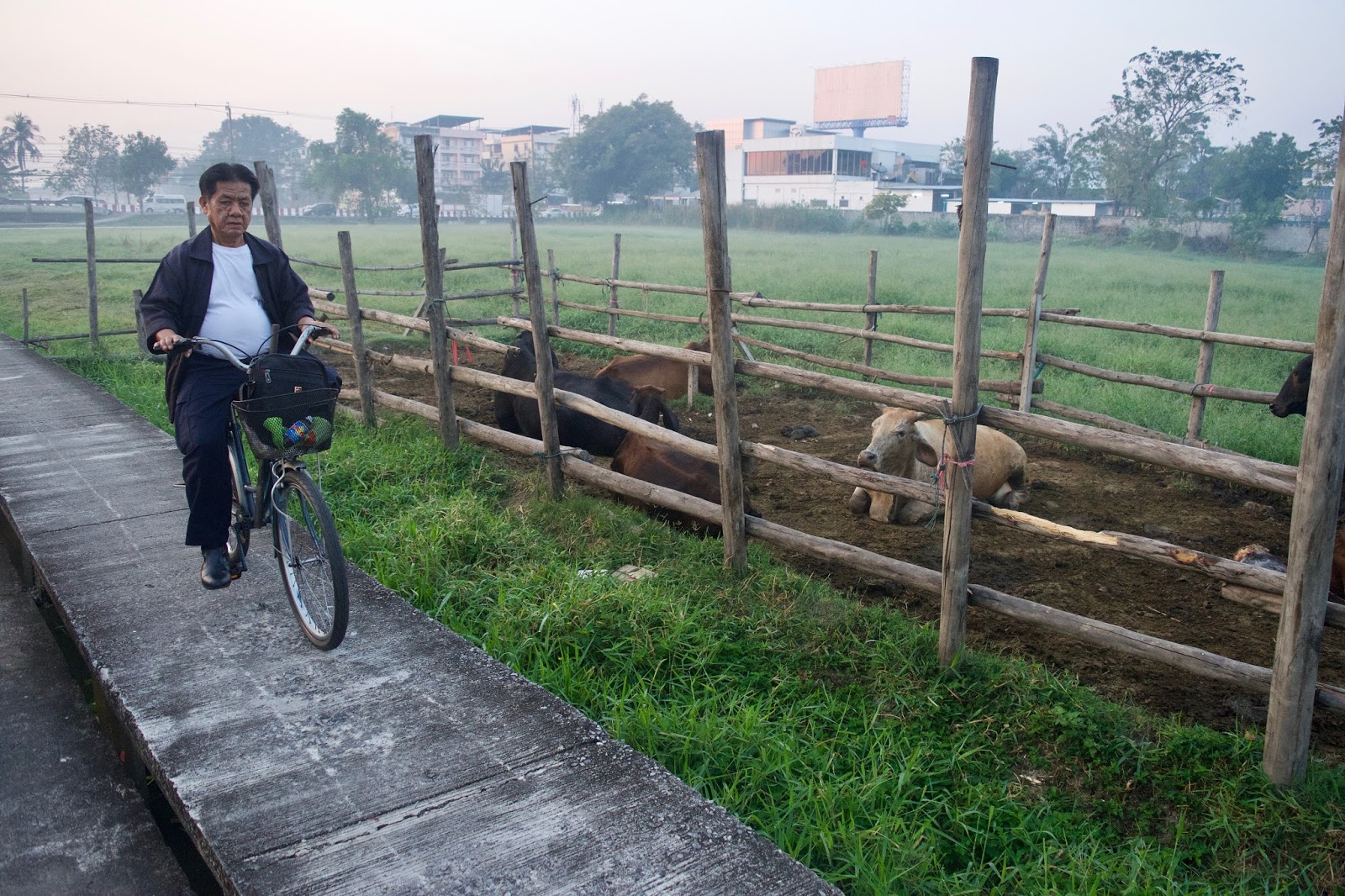
Small rural villages can be found in many locations within the Bangkok city limits. Here a man cycles past livestock that frequently graze in fields next to one of the busiest roads in the city.

Village head man who chatted with me each of the three times I visited.

A mother and child return home after walking another child to the main road to catch a bus to school. Many of the village children attend a school in the village; others go to different public schools nearby.

This is the Saen Saeb canal that runs the entire east-west length of Bangkok. It is the city's largest; the village is at the crossroads of it and two north-south feeder klongs. Here Jeremiah captures footage for an upcoming documentary. Notice the mosque in the distance. This part of Bangkok has a large Muslim population, thus there are many mosques along the Saen Saeb.

Many people pass over the bridges that span the klongs; they walk or take motorcycles or bicycles over. Along the big Saen Saeb, the bridges are arched concrete for strength as they are longer than those across the feeder klongs, which are mainly made of wood.

A typical happy scene at the entrance to a house along the Saen Saeb. On this (south) side, the homes are owned; across the canal are rooms for rent, bunched together and with corrugated tin roofs, many of them nearly rusted through after decades of use.

A villager plucks whiskers, a very common practice everywhere in Thailand.

Two feline residents. Dogs and cats are numerous along the canals.

Laundry day!

A beautifully restored century old Chinese Buddhist temple
along the northern klong tributary.

A man proudly displays his prized fighting cock. Cock fights are very popular in Thailand, a tradition that is centuries old. As a graduate of the University of Iowa I was surprised and amused to see his choice of boxer shorts.

At a very convenient spot on the klong near Seri Thai Road, this woman cooks up "guaytiow gai" (noodle soup with chicken) in huge bowls for 35 baht ($1). After two hot hours of rambling, it hit the spot and was chased down with ice cold beer.

Small fish caught in the klong and then set out to dry. People generally use them for cooking, but may also snack on the tough and stiff fish.

A cute resident of the village.

Water lilies (also lotuses) are ubiquitous in Thailand, growing in large ceramic pots ("aungs"), often sharing the space with small fish that people put in to eat mosquito larvae.  

These two friendly men turned the tables on us, taking photos of the two photographers visiting their village! (This happened on two different trips.)

This young boy appeared with his mother and gave us each a bottle of chilled fruit juice. The people in Thai villages are generally very friendly and inviting. It is refreshing to be welcomed by genuinely kind hearted people.

This woman wheels her cart through the village daily, selling home made sauces 
and soups.

Ice is big business in Thailand. This man delivers huge bags of ice to shops in the village. I asked him if he got tired carrying so much weight, and he replied, "No, they aren't that heavy." Sure. Call the chiropractor!

This pleasant lady chatted with us about life on the klong. She has lived in one of the rental rooms for 30 years. The rent is 500 "baht" ($15) per month. When she first moved in the rent was 5 baht! When asked what she liked about living in the village, she said, "I like the weather, and being on the water."

This young man married into a large family that has occupied homes in the village for 100 years. He raises Japanese chickens, turkeys and crayfish on a small organic farm. He gave us several fresh eggs to take with us.

The farmer's young son and wife.

The wife of the village head man spends a quiet moment on the klong. She and her husband are well known for their style of cooking various mushrooms, which they were preparing when we passed by and chatted with them.
I hope that you have enjoyed this virtual tour of a village in eastern Bangkok. Today the people of course have many modern conveniences, but still live a simple life, not much different than their grandparents did decades ago. They are kind hearted, happy and friendly. Not only is this a nice way to experience Thai culture, but it teaches me something about savoring and appreciating the simple things in life.