|
| Jasmine and bougainvillea blossoms with coins sit as centerpieces on a table near an altar at Wat Sri Bun Reuang in Bangkok |
One of the most important holidays in Thailand (as well as in neighboring Buddhist countries) is Makha Bucha ("Honor Buddha"), a day and evening of ceremonies at temples where devotees pray, give alms in the forms of monetary offerings to the temple projects or gifts to monks, and pay respects to Buddha through acts of devotion, such as placing gold leaf on statues and laying flowers on shrines. It is also a day when numerous lottery sales are made! This day was especially auspicious this year as the lottery drawing will be the next afternoon. Many lottery ticket salespeople were on hand throughout the day at the temple.
 |
| A colorful neon revolving wheel is set up the evening before Makha Bucha day. |
Makha Bucha falls on the first full moon of the third lunar month, which was March 1st this year. I visited one of my favorite temples in Bangkok, Wat Sri Bun Reuang, located in Bangkapi district on the Klong (canal) Saen Saeb. This small temple has unique events, often with touches of humor (the temple monks are very friendly and the displays are often playful), so I wanted to be there for this important day. The previous evening, as I returned from downtown on the canal taxi, I noticed the preparations being made for the holiday. I asked a senior monk what time the ceremony would begin, and he told me it would be in early afternoon. I returned the next day to find the ceremony already in progress.
All photos are copyright © by the author. It is illegal to use any of the images without permission. For information about use, please email me at jsscience@yahoo.com.
 |
| Devotees sit for hours under a canopy listening to teachings and observing monk rituals. The cotton strings are attached to an overhead grid that the monks made the day before. Symbolically, the thread connects all attendees to each other, and to the temple, eventually leading to the large Buddha statue inside. Notice that no one's feet are pointed forward, which would be in the direction of the monks. This practice places the "lowest" part of the body away from the monks (and also away from any Buddha statue present if in a temple) as a sign of respect. |
 |
| Prayer flags are also attached to each of the strings that touch the attendees. |
 |
| A senior monk places an offering on the altar that was used for the day's ceremony. Silver alms plates (actually decorated tin) with other offerings are displayed on the table. Each has been carefully decorated with marigolds and strings of jasmine blossoms and roses. |
 |
| Senior monks leave the covered assembly area to prepare for the upcoming ceremony. |
 |
| Not all devotees spent the time under the canopy listening to lessons. Many people went to various places on the temple grounds to pay respects in a number of ways. Here a woman prays while holding incense sticks with a monetary note wedged between wooden sticks that will be placed on the specially made columns in front of her. |
 |
| Visitors press gold leaf onto a series of spheres and a Buddha statue as a sign of devotion and respect. The gold leaf is usually bundled with a candle and three incense sticks that are available for a small donation to the temple. |
 |
| Wat Sri monks often use mannequins as displays, and there is usually a skeleton dressed and in various forms of prayer. I did not see it this time: perhaps it was too playful for this more somber celebration. |
I saw this "monk carousel" (click video play below) the first time I visited Wat Sri many years ago, and it is brought out only on special occasions. Devotees drop coins into the alms bowls as they revolve by. I have seen only one other such carousel in Thailand, but I am sure there must be more.
 |
| Monks stroll by palm readers and food stalls on the temple grounds. |
 |
| This senior monk displays traditional temple tattoos, which are done by specially trained monks using only a spike dipped in ink and wooden hammer. This style has become popular among westerners ever since Angelina Jolie got one in Cambodia. However, it is meaningful only to monks who have been educated in Buddhism and can read the ancient script. |
 |
| Monks circle the table of offerings, placing incense sticks in many of the foods, while the temple's highest ranking monk, or "ajaan", recites prayers and blessings. |
 |
| This unusually dressed man was known to many of the monks, but I am not sure of his particular status or reason for the atypical attire. He did not participate in the ceremony. This is just one more reason I like to go to Wat Sri: there is always something or someone new and interesting to see. |
 |
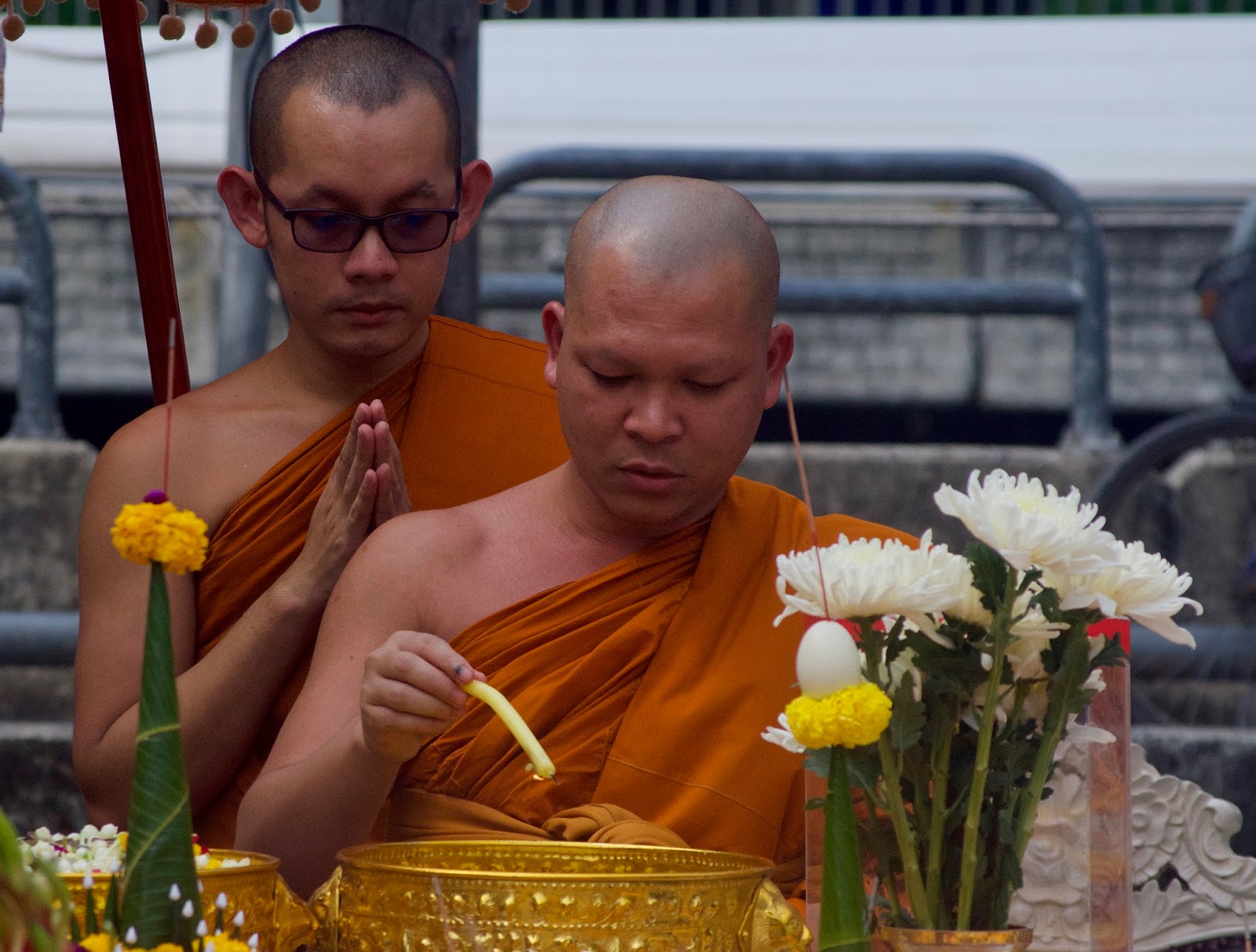
| A monk melts candle wax in order to affix the candle on a special tray as part of the prayer ceremony. |
 |
| Close up of the decorations on the altar. |
 |
| Musicians playing traditional instruments added musical interludes of traditional music. |
 |
| Monks sit under parasols held by attendants during the ceremony. |
 |
| One of the more intriguing offerings was this plate, with cigarettes and rolled leaves of "maag", the Thai betel nut plant, which many Thais smoke. I thought it odd, but apparently it is an old tradition. |
 |
| Garlands and gold leaf placed on a Buddha statue outside of the temple door. |
 |
| Inside the temple was a tray of vessels filled with holy water. Devotees can ask a monk for blessings while pouring the water into a cup. After the brief ceremony, the water is poured on either a special plant or tree outside, or on one of the figures on the temple, such as a dragon, god or goddess (from Hindu legends). |
 |
| This is a detail of the meticulously hand painted wooden doors of the temple, which is typical throughout the kingdom. This portrays "Hanuman", a monkey god of Indian legend, who played a part in the epic poem Ramayana. Thai Buddhism has adopted many Hindu legends and gods, as India is where Buddha lived (as a Hindu). |
 |
Every once in a while I am extremely fortunate to come across beautiful practices unexpectedly. I had nearly decided to go home (it was very hot), but took a few minutes to go inside the small temple, where I was one of only three visitors. As I was about to leave, a stream of young monks entered and took their places in long rows, filling the temple floor. I asked one how many there were, and he answered "95". Ninety-five monks in a temple! I had only a few minutes to take photos and record one of their chants before the doors were closed.
|
 |
| A view of the gathering. Seated cross-legged before the prayers, they will change position as shown in the next image. |
 |
| During prayers or ceremonies in the temple, monks (particularly young monks) sit with their weight on knees and toes. Elder monks usually sit cross legged or sit on chairs. |
The haunting sound of 95 chanting monks. Click on the video below:
Thai (Theravada) Buddhism is traditional, ceremonial and disciplined. 95% of Thais consider themselves Buddhist, but not all are strict adherents, and almost everyone respects whatever level of practice others have adopted (Thai Buddhism has incorporated some traditional animist beliefs, as well as Hindu and Chinese Buddhist practices). Although monks are revered and follow strict interpretation of the teachings, I have found them to be generally friendly and they welcome respectful interactions with the general population including foreigners, especially those who speak Thai and practice respectful posture. It is a wonderful experience to observe a traditional Buddhist holiday celebration: it has helped me learn more about Buddhism, as well as Thai culture.